EDUCATION

-
My name is Patty McNinch, and I am the Tuscola County Education Technician. I retired from teaching after 32 years but felt that I still had lots to offer our families and youth in outdoor education, conservation, gardening practices and forestry. I have always had a passion for the outdoors since my childhood. I love plants, trees, wildlife, hiking, camping, gardening, and birding. I am so excited to share some of the wonderful things we are doing here at the Tuscola Conservation District to educate others on conservation practices. I am available to visit your school for a presentation, assist with a poster contest or photo contest, assist with school gardens, assist with a school field trip, or offer a community program. I look forward to speaking with you! Please feel free to contact me with any questions.
My contact information is:
1-989-325-7057
Scroll down or click on the drop down choices on the menu bar to check out some of the activities that have been happening in our school and community education programs.
Bugs, Birds & Mammals – Oh My!
Submitted by: Patty McNinch
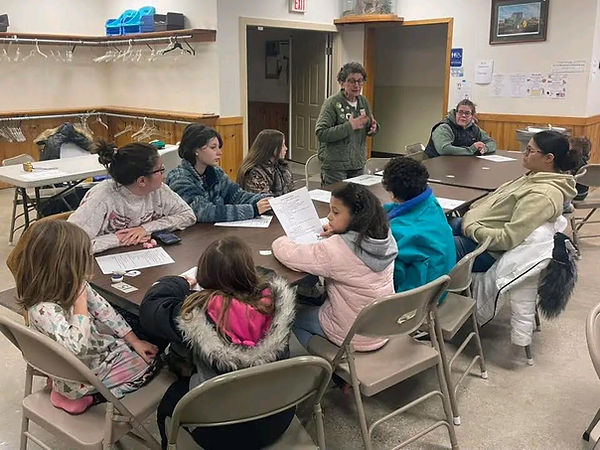
Tuscola Conservation District partnered with the Richville Conservation Club to give students from a homeschool group an exciting nature adventure.
Students and parents were welcomed to the Richville Conservation Club by Patty McNinch, the Education Technician from Tuscola Conservation District, and Matt Lefler, the Michigan Education & Outreach Coordinator for Pheasants Forever and a member of the Richville Conservation Club. Both spent part of the afternoon with 15 students and adults from a homeschool group from the Millington area. They spoke about different plants, animals and bugs that can be found in nature. Additionally, Matt gave participants information about the Richville Conservation Club. He invited the participants to continue learning about nature and to continue doing fun things outside.
Patty McNinch followed by asking participants about what can be found outside in nature. She gave information to everyone on how to begin nature journaling. Handouts were provided showing examples of drawings, so participants had a starting point for the activity. Patty felt that it was important that the participants felt comfortable with their journaling skills before beginning the activity.
One of the skills introduced to the participants was the practice of using as many of their senses as possible during the activity. She encouraged participants to use their sight, hearing, touch and smell to become connected to nature around them in a deeper sense. Using their senses gives them a way to experience nature more completely. Three short statements that are part of the “Beetle Project” and “John Muir Laws” learning routine practices were also used to promote a connection with nature. These statements are meant to encourage curiosity and scientific thinking through more complex observation skills. As referenced by the “Beetle Project” and “John Muir Laws” these three short statements “I notice”, “I wonder”, “It reminds me of”, break down observation skills into three important steps which include describing sensory details (“I notice”), asking questions (“I wonder”), and making personal questions (“It reminds me of”). Using this method helps participants to slow down and engage with nature more completely. It helps individuals build critical thinking skills that are essential to building relationships with the things around them.
After all this discussion, it was time to get going outside! Each participant was able to choose a backpack which had all the supplies they needed for a nature journaling experience. Inside the backpacks, participants found a clipboard, a journal booklet, a magnifying glass, a pencil pouch with regular pencils, colored pencils, a pencil sharpener, and an eraser in it. All the supplies used for this activity were provided with a $1,000.00 grant from the Michigan Alliance for Environmental and Outdoor Education (MAEOE) and from the Tuscola Conservation District. Thank You!
All the participants were so excited to get their own backpacks and head outdoors! On their way, they observed many amazing things. Puffer mushrooms, acorns, pinecones, dead flower heads with tiny seeds inside, fuzzy leaves, thorny stems, and many other amazing things. Then they sat down and began drawing in their journals. Some of the students collected items to finish their sketches later.
This was a great day that was full of adventure, asking questions and using their senses to connect with the natural world. Offering outdoor and environmental education activities is key to the development of a deep connection to the natural world by incorporating active, sensory-rich education. Student directed activities outdoors in nature offers a glance into the world around them in ways a classroom is unable to do. These kinds of activities help individuals grow into thoughtful stewards who protect their planet.